Why the Shift to WCAG 3.0 Changes Everything for Your Brand
For years, digital accessibility has been treated like a fire drill: a frantic rush to tick boxes, fix "errors," and satisfy a technical auditor. But as an AuDHD leader, I know that a "compliant" website isn't always a usable one.
As of early 2026, we are in a unique transition. While WCAG 2.2 is the legal standard you must meet today, the WCAG 3.0 (Silver) working drafts released in late 2025 are already reshaping how forward-thinking brands think about the user journey.
The 2026 Reality: WCAG 2.2 is the Law, 3.0 is the Future
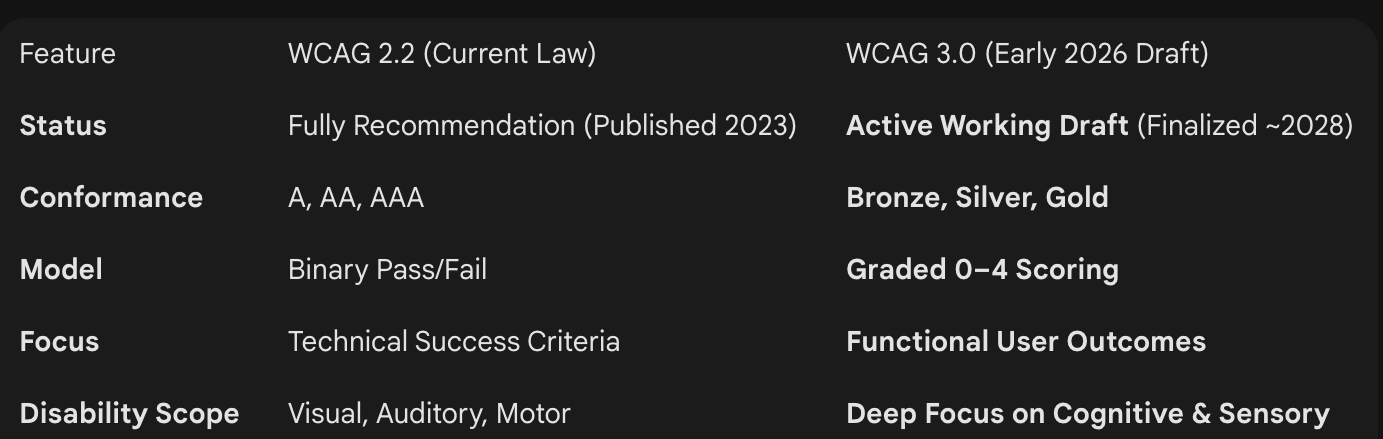
Let’s be clear: WCAG 3.0 is still a "Working Draft." It isn't expected to be finalised until at least 2028. However, the principles within it, specifically the focus on Cognitive Accessibility, are what will separate the industry leaders from the laggards in 2026.
Why the "Silver" Era is a Neuro-Inclusive Revolution
The current system (WCAG 2.2) is binary: you pass or you fail. This "all-or-nothing" approach often fails neurodivergent users because it ignores the nuances of cognitive load and sensory processing.
WCAG 3.0 changes the game with three major shifts:
The 0–4 Scoring System: Instead of a simple pass/fail, outcomes are rated on a scale. This allows for "Partial Compliance" and encourages continuous improvement.
Bronze, Silver, and Gold: Goodbye A/AA/AAA. Bronze will be the new baseline (roughly equivalent to today's 2.2 AA), while Silver and Gold will require holistic testing, actual usability trials with assistive tech and real human feedback.
Expanded Scope: 3.0 moves beyond the web to include the entire digital ecosystem, IoT, mobile apps, and even XR (Extended Reality).
The IMPACT™ of Assistive Technology
In 2026, accessibility isn't just about your code; it's about the tools you provide. Solutions like toolbars are essential bridge technologies but just make sure they are doing the job that needs to be done, many don’t. The good ones allow users to customise their own experience, changing fonts for dyslexia, adjusting colour contrast for sensory issues, or using text-to-speech, aligning perfectly with the WCAG 3.0 goal of user-centered outcomes.
Actionable Advice for 2026
Stick to the Law: Ensure your site meets WCAG 2.2 AA to comply with the European Accessibility Act (EAA) and UK regulations.
Adopt the 3.0 Mindset: Start measuring "Task Completion." Can an autistic user successfully navigate your checkout without being overwhelmed by "visual noise"?
Future-Proof with Tools: Leverage assistive toolbars to give your users the "Gold" level of personalisation today.
The shift is simple: WCAG 2.2 tells you what to fix. WCAG 3.0 tells you how to care.
Don’t Just Comply—Connect.
The transition from WCAG 2.2 to 3.0 represents a monumental shift in the digital marketing world. It is the moment we stop asking "Is this site broken?" and start asking "Is this site welcoming?"
For business owners and marketing leaders, this isn't just about avoiding a legal headache under the European Accessibility Act. It’s about ensuring that your digital door is open to everyone, regardless of how their brain processes information or how they navigate the web.
Whether you are looking to audit your current site against 2.2 standards or want to lead the pack by adopting a 3.0 "Human-First" mindset, I’m here to help you navigate the complexity.
Ready to turn accessibility into your competitive advantage?
Audit Your Impact: Let’s look beyond the code to see how your site really performs for neurodivergent users.
Future-Proof Your Strategy: Book a consultation to align your 2026 digital roadmap with the upcoming "Silver" standards.
Empower Your Users: Discover how integrating assistive technology like Recite Me can elevate your UX from Bronze to Gold.
Let’s chat.