brightonSEO Wildcard Speaker: Is Your Site Invisible to AI?
Quick summary:
On Friday 9 October at 9:30am, I opened brightonSEO 2026 as part of the headline segment in Auditorium 1 at the Brighton Centre. My talk, "If Your Website Isn't Accessible, AI Search Will Make You Invisible", argued that screen readers and AI crawlers read the same code, so accessibility fixes are also AI visibility fixes. I was also named the event's Wildcard Speaker.
Thank you to everyone who came, to everyone who stayed to listen, and to the brightonSEO team for trusting me with that important slot.
What did I talk about at brightonSEO?
My talk was called "If Your Website Isn't Accessible, AI Search Will Make You Invisible." It was a technical talk for a room full of SEO specialists, so I didn't spend time on the basics.
The core idea was simple:
Screen readers and AI crawlers read the same code. Fix it for one and you've fixed it for both.
Screen readers don't read your rendered page. They read the accessibility tree that the browser builds from your DOM and ARIA. LLM crawlers parse that same DOM. So alt text, heading hierarchy, ARIA landmarks, captions and clean semantic HTML aren't a trade-off against search visibility. They are the machine-readability layer.
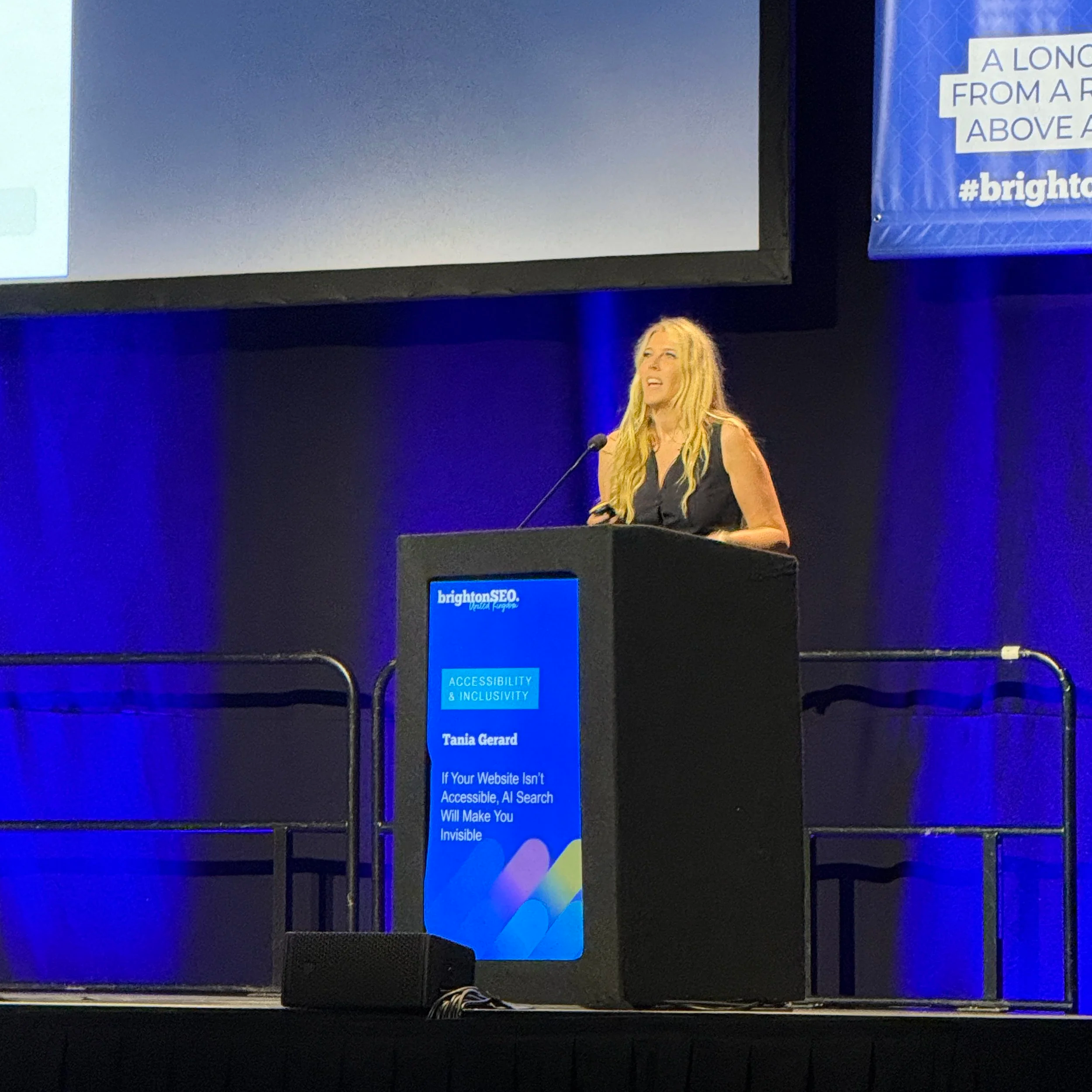
Tania Gerard speaking on stage in Auditorium 1 at the Brighton Centre during brightonSEO 2026
What were the key takeaways from the talk?
For anyone who wasn't in the room, these are the points I came back to:
The search journey has changed. AI Overviews, Perplexity and ChatGPT Search give one synthesised answer instead of ten links. You are either citable, or you are functionally invisible.
LLMs choose who to cite through a chain. Crawl and render, parse the DOM, chunk and embed, retrieve and rank, then give one answer. Your heading structure decides where chunks are cut.
Accessibility failures are visibility failures. Missing alt text, text baked into images, client-side-only content, uncaptioned video, low contrast and keyboard traps all leave crawlers with less to work with.
Specific beats vague. Content that names who it serves and states structured facts gets cited. Generic copy gets skipped.
The business case is real. The Purple Pound, rising tribunal claims and cases such as Robles v Domino's all point the same way.
Three steps to act now. Audit accessibility and representation, integrate SEO, PR, accessibility and brand signals into one workflow, and test regularly across AI search platforms.
Where can I learn more about accessibility and AI search?
I built the talk around my IMPACT™ framework for inclusive visibility:
Inclusive Language
Machine Readable
Prove Credibility
Accessible Design
Community & Representation
Test & Iterate
If you'd like to put this into practice on your own site, you can book a conversation with me or get in touch.
Who is Tania Gerard?
I'm the founder and Managing Director of Tania Gerard Digital, a UK consultancy specialising in accessible marketing and neuroinclusion. I'm CPACC-certified through the IAAP, a TEDx speaker, a UK Parliament ADHD Champion and an ADHD UK Ambassador.
Event details
Event: brightonSEO 2026
Venue: Brighton Centre, Brighton, UK
Dates: 8 and 9 October 2026
My session: Friday 9 October, 9:30am, Auditorium 1 (opening segment, full room)
Talk: If Your Website Isn't Accessible, AI Search Will Make You Invisible
Recognition: Named Wildcard Speaker of the event
Contact: hello@taniagerard.co.uk · taniagerard.co.uk