UK Airports Are Getting More Accessible. Is Your Website?
The good news first
For the first time, not a single UK airport has been rated ‘poor’ or ‘needs improvement’ on accessibility.
That’s the headline from the UK Civil Aviation Authority’s Airport Accessibility Report 2025/26. It’s a big moment. When the CAA launched its framework in 2014, 13 airports sat in those bottom two categories.
But here’s the number that stopped me in my tracks. Since 2015, requests for passenger assistance have risen by 115.8%. Overall passenger numbers grew by just 23.9% in the same period.
Demand for accessibility isn’t creeping up. It’s doubling. And that’s not just an airport story. It’s a story about every business that serves the public — including yours.
The report at a glance
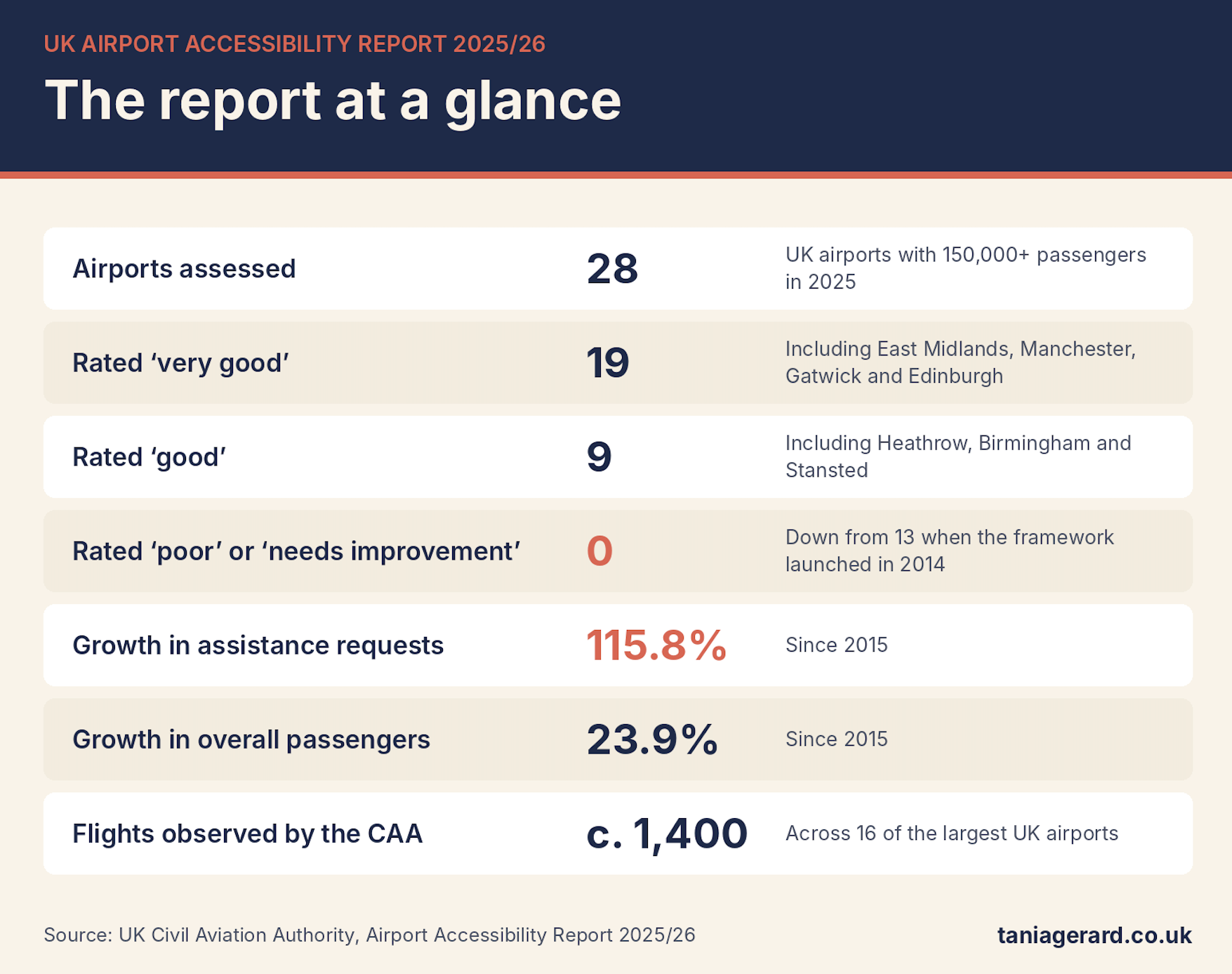
The UK Civil Aviation Authority's Airport Accessibility Report 2025/26 at a glance. 28 airports were assessed. 19 were rated very good, including East Midlands, Manchester, Gatwick and Edinburgh. 9 were rated good, including Heathrow, Birmingham and Stansted. None were rated poor or needs improvement, down from 13 in 2014. Since 2015, assistance requests have grown 115.8%, compared with 23.9% growth in overall passengers. The CAA observed about 1,400 flights across 16 of the largest UK airports.
The gap that hasn’t closed
Progress is real. But the report is honest that disabled passengers still have a worse experience.
88% of all passengers were satisfied with air travel — the highest since the CAA’s survey began in 2016.
For passengers with accessibility or disability needs, that drops to 82%.
58% of disabled consumers said they had difficulty accessing or using airports and flying.
Six percentage points might not sound like much. But think about it in your own business. If one group of customers was consistently less happy, and more than half of them hit barriers, would you call that a win?
The CAA’s Head of Consumer Protection, Anna Bowles, put it simply: “we cannot be complacent.” The regulator is consulting on a tougher framework, and the Civil Aviation Bill could give it new enforcement powers. The direction of travel is clear. Expectations go up, and accountability follows.
Four lessons every business can take from this
Airports didn’t get here by accident. They got here because someone measured, listened and held them to account. You can do the same, without waiting for a regulator.
Measure it, or it won’t move. The CAA scores airports on waiting times, data quality and user satisfaction. Most businesses have never audited their own accessibility once. You can’t fix what you’ve never looked at.
Ask disabled people, not just about them. Airports are assessed on how well they consult disabled people through accessibility forums. Your customers and staff are the experts in what gets in their way.
Plan for demand that’s already here. Assistance requests more than doubled in a decade. Around 1 in 4 UK adults is disabled. If your website, content or customer journey isn’t built for them, you’re turning away a huge market.
The journey starts long before the terminal. A smooth assisted boarding means little if the booking page won’t work with a screen reader. For most businesses, the first door a customer meets is digital. That’s where accessible marketing comes in.
Don’t forget the needs you can’t see
The report found the most common needs were around walking, standing and carrying luggage. Those matter enormously. But plenty of barriers are invisible.
As an ADHD Champion and neurodivergent founder, I know how overwhelming a busy airport can be. Noise. Crowds. Changing gate information. Unclear signage. The same is true online. Cluttered pages, wall-of-text emails and confusing forms are the digital version of a chaotic departure lounge.
Neuroinclusion isn’t a nice extra. It’s part of accessibility. And it’s often the part businesses miss.
How Tania Gerard Digital can help
At Tania Gerard Digital, we help organisations do what the best airports have done: measure honestly, listen properly and improve every year. We’re the UK’s first consultancy to combine neurodiversity training with accessible marketing strategy.
Accessibility audit. A clear, practical review of your website, content and customer journey against WCAG 2.2 AA. You get a prioritised action list, not a 90-page report nobody reads.
Fractional Accessibility Director. Ongoing senior support to embed accessibility across marketing, digital and comms, without a full-time hire.
Neuroinclusion training. Practical sessions for managers and teams, so neurodivergent customers and colleagues can thrive.
The IMPACT™ Framework. Our proprietary approach to building accessibility into how you plan, create and measure — so it sticks.
The results speak for themselves:
100% WCAG 2.2 AA compliance for an NHS trust
A 34% reduction in 90-day staff attrition at Greene King, saving around £227k a year
Around £180k in additional donations for Help for Heroes
Ready for take-off?
UK airports took a decade to go from 13 failing ratings to none. Your business doesn’t need ten years. It needs a clear starting point.
Book an accessibility audit or a free discovery call at taniagerard.co.uk. Let’s find out where your barriers are and remove them.
Sources
UK airports improve accessibility as demand for assistance services reaches record levels, THIIS, 5 August 2026
UK Civil Aviation Authority, Airport Accessibility Report 2025/26